

Carbon Neutral Basic Policy
「Based on the management philosophy,
aiming for being necessity
of the customers
and society with contribut to the environment willingly,
initiatives for the climate change is
recognized to one of the most significant task for us.
Ogawa sangyo aim for
Carbon Neutral of 2050,
for contribute to decarbonized society
through reducing carbon dioxide
emissions at the factories
and the officies,
developing both long-term goal
and mid-term goal 2030 as the milestone
and strive for achieving a goal.

Measures to the Carbon Neutral
Greenhouse gas reduction target and approach of Ogawa sangyo is acknowledged to the scientific basis standard that is conform to Paris Agreement and obtained Science Based Targets initiative (SBTi).
Ogawa sangyo get to contribute to the decarbonized society with proceeding of reduce carbon dioxide emissions of throughout the whole life cycle from material procurement to disposing, recycling.
Categorizing the whole company into 4 categories, Sales, Manufacturing, Sales assistant, Management, setting the goals separately, getting on for achieving the carbon neutral on 2050 as a united company with sharing the activity details of each categories monthly basis, visualizing the amount of each groups’ emission amount and advance improvement activities.
What is SBTi (Science Based Targets initiative)
SBTi is the organization that promote companies setting the reducing GHG emissions of science-based target for aiming the limiting of brobal average temperature rising that caused by climate change within 1.5℃ compare to the pre-industrial levels.
The acceditation criteria for SBTi set Standard, which is short-term goal(year of 2030), 1.5℃ goal, as well as long-term goal(year of 2050), Net-Zero goal, is a global standard for goal setting based on the Paris Agreement, global warming of 1.5℃ above pre-industrial levels.
“SBTi APPROVAL LETTER”
Carbon Dioxide Emissions Reducing Goal
Ogawa sangyo go forward for contribute to the decarbonized society inspite of having active business operations with setting the long-term goal of 2050, and the mid-term goal of 2030 as milestone along with reviewing and setting changing business environment as needed, concerning of factories and officies (scope 1 and 2) and the products, waste(scope 3).
| Category | Period | Must Achieve Goal |
|---|---|---|
| Scope 1 , 2 |
80th fiscal year (2030) |
Reduce over 42% against the Carbon Dioxide emissions 2021st fiscal year |
| 100th fiscal year (2050) |
Strive for Carbon Neutral |
| Category | Period | Stretch Goal |
|---|---|---|
| Scope 3 (Waste) |
80th fiscal year (2030) | Reduce over 42% against the Carbon Dioxide emissions 2021st fiscal year |
| 100th fiscal year (2050) | Strive for No waste matter | |
| Scope 3 (Products) |
80th fiscal year (2030) | Strive for taking the green products to sales more than 15% of total sales |
| 100th fiscal year (2050) | Strive for taking the green products to sales more than 50% of total sales |
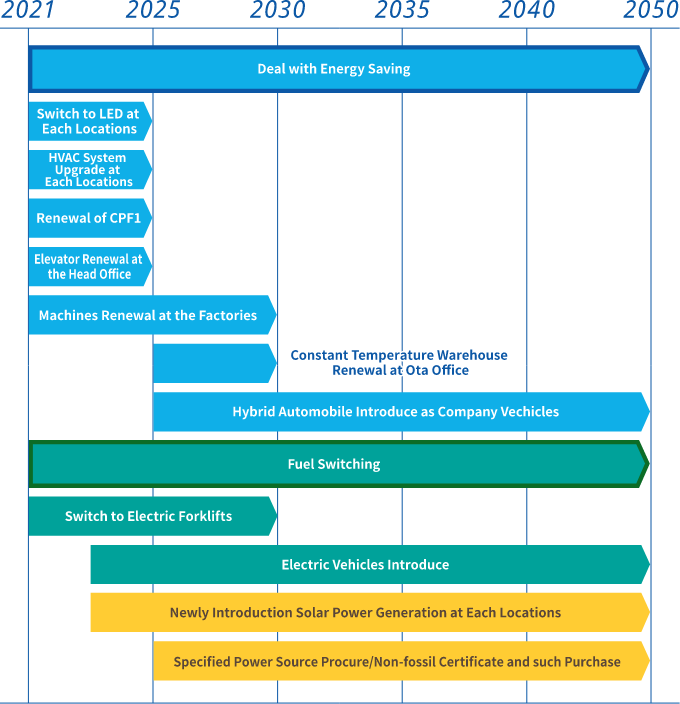
■ Roadmap to Achieve the Goal
Carbon Dioxide Emissions Reducing Achievement
CO2 emissions of Ogawa sangyo for fiscal year 2025 totaled 515.9 t-CO2.
Compared to 2021, breakingdown emissions of 2025 shows that reductions are smoothly progressing through out all the categories.
The operation of solar power systems as well as the introduction of hybrid automobiles enabled to reduce energy consumption.
Furthermore, the ratio of CO2 emissions to the sales calculation shows the lowest on record figure,
stood at 4.7%(down from 7.43% in 2021) and this indicate even though the sales expanding, efficiency of CO2 emissions improving continuously.
In the coming fiscal year, we will continue to strive to reduce CO2 emissions by installing solar power systems, introducing energy-saving equipments, and switching to hybrid and electric automobiles.
* Emissions are calculated using the standard for calculating, Basic Guidelines for Greenhouse Gas Emissions Calculation Across the Supply Chain Ver.2.4, both Ministry of the Environment and Ministry of Economy, Trade and Industry developed March 2022, and Emission Factor Datebase for Supply Chain GHG Emissions Calculation Ver.3.3, Ministry of the Environment developed March 2023.
* For Scope2, emissions are calculated using the market-based accounting (emissions factors by electric power supplier).
* For overseas offices, emissions are calculated using the datebase of Institute for Global Environmental Strategies.
■ Scope1,2 Carbon Dioxide Emissions,
Scope 3 Carbon Dioxide Emissions(waste),
Carbon Dioxide Emissions (total)
(Unit : CO2)
| Scope1,2 Carbon Dioxide Emissions |
Scope3 Carbon Dioxide Emissions (Waste) |
Carbon Dioxide Emissions (Total) |
|
|---|---|---|---|
| 2021 | 605.01 | 89.71 | 694.72 |
| 2022 | 563.69 | 27.01 | 590.60 |
| 2023 | 602.86 | 16.41 | 619.27 |
| 2024 | 573.61 | 13.16 | 586.77 |
| 2025 | 498.98 | 16.88 | 515.86 |

| 2030 (Target Value) |
350.90 | 52.03 | 402.94 |
|---|
Carbon Dioxide Emissions Reducing Activitie Details
| Period | Approaches | ||||||||||||
|---|---|---|---|---|---|---|---|---|---|---|---|---|---|
| 2021 |
|
||||||||||||
| 2022 |
|
||||||||||||
| 2023 |
|
||||||||||||
| 2024 |
|
||||||||||||
| 2025 |
|
